
Pennsylvania Parole Release Paths
Pennsylvania state parole begins only after release from a DOC sentence under Parole Board authority. Field supervision now sits within the Department of Corrections. A Cameron County state prisoner can be paroled to a community address, a community corrections center, a detainer, or service of another sentence. Only the first two may reflect movement toward community placement, and even a community corrections center remains a structured state placement. The Board Action identifies what the Board granted. The state locator helps show whether the decision has been carried out.
A parole grant is not the same as a physical release. Home-plan approval, programming, another sentence, or a detainer can delay or redirect the move. A detainer is a hold based on another authority or proceeding. When a Board Action grants parole to a detainer, the person may leave a state institution but remain confined elsewhere. Record the destination and current location before describing the event as a community release.
Search Pennsylvania Parole Supervision
The official Inmate/Department Supervised Individual Locator has a distinct Department Supervised Individual mode. Begin with the last name. Refine with the first name, parole number, date of birth, committing county, or location only when needed. Cameron as committing county can narrow a state case, but a person may have commitments from more than one county. The parole number is the strongest match when it is known.
- Select Department Supervised Individual Locator, not the inmate-only mode.
- Search the last name and compare identity details.
- Use the parole number, date of birth, or Cameron committing county to refine.
- Read Current Location, Permanent Location, Release Date, and Last Updated Time as displayed.
- Contact the listed district office or request the state record when a detail is disputed.
A returned district office is a positive lead for state community supervision. Search the inmate side too when release is recent or a return to custody is possible. The locator updates daily, so it is not a minute-by-minute movement log. A missing result does not establish discharge. It can reflect spelling, timing, full discharge, or a different supervision system.
Pennsylvania Parole Record Fields
The supervised-person result contains clues rather than a full supervision file. Keep each label intact. A current location can identify a field office. A permanent location adds context but should not be treated as a guaranteed place to find a person. The last update marks the age of the displayed record.
| Field | How to read it |
|---|---|
| Parole number | State identifier used to confirm the correct supervised person. |
| Current Location | May name the DOC district office responsible for state supervision. |
| Permanent Location | A state location field that does not replace direct office confirmation. |
| Committing County | Connects the supervision record to the sentencing county. |
| Release Date | The locator's date label, which must be read with the record status. |
| Last Updated Time | Shows how current the public display was when checked. |
The state locator interface shows separate inmate and supervised-person modes.
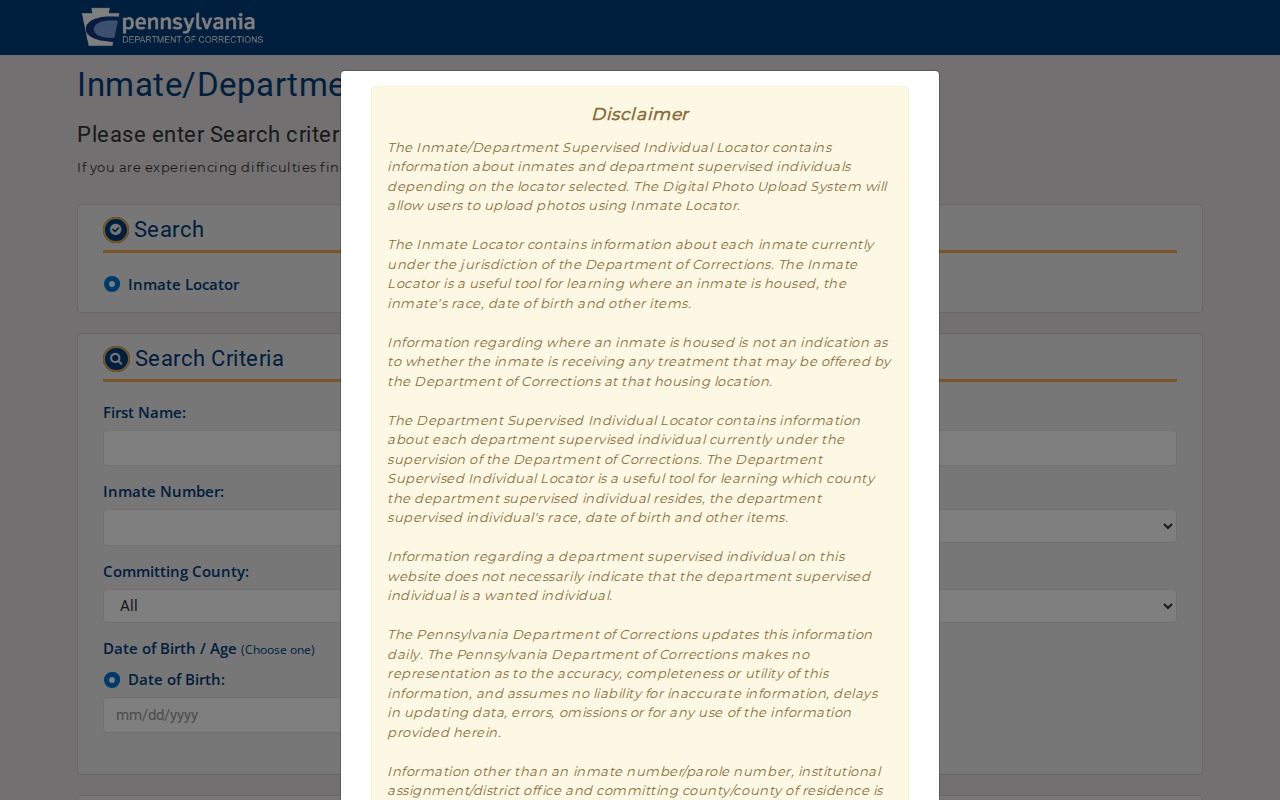
The separation helps prevent a state parole record from being confused with continued institutional custody.
Pennsylvania Parole Board Actions
The Pennsylvania Parole Board decides parole for eligible state prisoners. Its public meetings calendar is administrative and is not a name-by-name list of upcoming institutional interviews. Nor is there a public decisions search like the UJS docket. The individual result is recorded in a Board Action, which tells the incarcerated person whether parole was granted or refused and can state reasons, conditions, or a later review point.
A grant can direct release to the street, a community corrections center, a detainer, or service of another sentence. A refusal can set another review month or require service to the maximum. A review month creates no right to leave prison in that month. Initial and re-parole decisions may take up to about six weeks after interview, depending on the case, and the final action is delivered to the incarcerated person before public release.
The official decision overview explains Board voting and review. Monthly statistics are aggregate totals, not named outcomes. For a particular Cameron County sentence, use the person or authorized record route, the Board contact, and the locator after the order is carried out.
- Parole
- Conditional community custody during the remaining state sentence.
- Re-parole
- A later release decision after recommitment or a parole violation process.
- Absconder
- A supervised person alleged to have stopped reporting or left supervision.
- Discharge
- Formal completion of the state supervision term.
Verify Pennsylvania Parole Discharge
Discharge ends the relevant state supervision term. It should not be inferred from silence in the locator. Ask the listed district office whether it can confirm current supervision or direct a records request. For an existing release, movement, or discharge record, use the DOC Right-to-Know service and identify the parole number, inmate number, Cameron commitment, and approximate date.
Use UJS Case Search for the Cameron sentencing order and later court filings. A parole record does not erase the conviction or replace the sentencing docket. If a revocation hearing results in recommitment, the person can return to prison. If supervision continues, a district office remains the better operational contact. PA SAVIN may supply state-parole event alerts, but an alert is not a certified discharge document.
State absconder information should be handled through the official channel. The documented state tip line is 1-800-932-4857 and the email is RA-CRabscondertips@pa.gov. Never approach a person based on a locator flag. A warrant or absconder allegation does not undo the historical fact that the person once left prison, but it can change current legal status.
Pennsylvania Parole Violation Records
State parole conditions govern conduct during the balance of the sentence, but the public locator does not publish a full list of individual conditions. The Board Action and supervision records are better sources. When an alleged violation occurs, a warrant, detention event, preliminary process, or revocation hearing may follow. Revocation means the Board determines whether parole should continue or whether the person should be recommitted. Recommitment can return the person to a state institution and produce new sentence calculations. It does not change the historical release date that began the parole period.
The official revocation-hearing information distinguishes continuation on parole from recommitment. A PA SAVIN alert may report a state-parole custody event, but the alert is a notice rather than the final legal record. Save its event label, reporting agency, date, and time. Then compare the supervised-person locator, Board record, and any new docket activity. An escape, furlough, transfer, detainer release, and lawful community release have different meanings.
Completion also requires care. Parole ordinarily continues within the minimum-to-maximum sentence framework until lawful discharge. A person can move between field offices without ending supervision. Likewise, a change from an institution to a community corrections center may reflect a Board-approved placement rather than unrestricted street release. The locator's Current Location and update time help identify the operational office, while the discharge record confirms that state supervision actually ended. Cameron County residence alone does not transfer this state authority to the 59th Judicial District.
Cameron County Parole Boundary
State parole and Cameron County probation are different systems. State parole follows a Pennsylvania DOC prison sentence and uses DOC field offices. County probation follows an order of the 59th Judicial District and is handled through the Cameron County courthouse office. A person released from a surrounding county jail can be on county probation without appearing anywhere in the state supervised-person locator.
First read the Cameron docket. A state commitment points toward DOC and the Parole Board. A county sentence with probation points toward the 59th Judicial District. If the record is unclear, contact the office tied to the sentence rather than treating a failed state search as proof that supervision ended. The PA SAVIN coverage statement includes state parole but does not promise ordinary Cameron County probation records.
Note: The supervising authority, not the location of arrest or residence, determines which parole or probation record can confirm current status.
Find Cameron’s Releasing Facility
Cameron County has no jail of its own. The dated statewide routing source lists five surrounding housing counties, so the Sheriff must identify the current physical custodian. This step matters before a state parole search because release from a county jail can lead to county probation, while transfer into DOC can later lead to state parole. The institution and sentence determine the right supervision branch.
Elk Release Counts Need Context
Elk Prison Board minutes published 287 total bookings for 2024 versus 334 in 2023 and reported 13 bookings with 11 releases at the January 2025 point. Those figures combine all Elk occupants. They do not count Cameron state parole cases and cannot show whether a named person entered a DOC district office.